Friday, 10 May 2024
Victory at Trinity!!
Saturday, 4 May 2024
All power to the student protest on Gaza at Trinity College Dublin!!
Academics for Palestine statement in support of TCD student encampment
Academics for Palestine strongly support the actions taken today by student activists in Trinity College Dublin. In joining the Palestine solidarity encampments that have spread across university campuses in the United States, France, Australia, Britain, India, Tunisia, Japan and beyond, these students are showing a degree of moral courage and leadership that has been distinctly lacking amongst our university administrations.
Students around the world are justifiably seeking to hold their academic institutions to account for their silence and complicity with the ongoing genocide in Gaza. We admire their courage in standing against a US-funded, EU-assisted genocide and we join them in demanding that their universities take similarly principled stands. To date, however, these demands have been ignored.
Across the island of Ireland, we have witnessed our university administrations legitimate their 6+ months of silence on Israel’s atrocities against the Palestinian people by asserting that they are holding a neutral position in defence of academic freedom. To remain silent in the face of this genocidal war on occupied Palestine is not neutrality, but complicity. Nor is the call for ceasefire a controversial matter; it has the overwhelming support of the people of Ireland as well as the Irish government.
We support the students' demands that Irish universities take concrete steps. Over the past 6 months, the demands of student groups, third-level campus staff groups, and Academics for Palestine have been expressed repeatedly and consistently. They include:
1) Severing any existing institutional partnerships, projects or affiliations with Israeli universities and state institutions.
2) Disclosing and divesting from any financial complicity in Israeli occupation and from companies involved in violations of Palestinian rights.
3) Divesting from any holdings in companies associated with weapons development or arms manufacturing, and withdrawal from any projects involving partners associated with the Israeli security, surveillance technology or arms industries.
4) Making an unequivocal statement of solidarity with the people of Palestine, condemning the ongoing genocide, apartheid and occupation they face.
5) Committing to provide substantial material and logistical support for displaced Palestinian students and academics to study and work in Ireland.
These demands should no longer be cast as radical, they are the least our institutions should be doing amidst the ongoing destruction of Gaza. They follow the lead of principled student movements as well as the longstanding principles of the civil society-led Palestinian Campaign for the Academic and Cultural Boycott of Israel. Indeed, Irish third level institutions are completely out of step with the broader public in Ireland in their refusal to deplore the Israeli state’s genocidal atrocities in Palestine. So we will continue to repeat and insist on these demands until they are met. We do so inspired by our own students and students rising around the world, and with the aim of reclaiming Irish universities as spaces of justice, anti-racism, and anti-colonialism.
Monday, 22 April 2024
Over 100,000 visits!
I started this blog in April 2012. I have been a writer and teacher for a long time, starting well before that time, and I'd also contributed to political discussion and writing and speaking, well before that time. But I decided that a blog would offer me a new outlet, while also preserving the odd occasional piece I might publish.
I wrote and write mostly about politics and academic matters, though the blog could hardly be called 'academic' in tone. Sometimes I write about travel or about other experiences, or other kinds of cultural matters. To my amusement, the most read blogpiece has long been my extended grousing about RTE Radio 1 'Why RTE Radio 1 Is So Awful', which has garnered suspiciously high readerships in eastern Europe and in the Far East. Some of my 'readers' may be bots, but I don't care - this morning, the total number of visits to the site has reached 100,039 and I regard this as a matter to celebrate.
So - my warm thanks and my genuine appreciation go to my readers and followers! And, a luta continua - the fight continues.
Conor
Wednesday, 28 February 2024
Past and Present - Gramsci and Critique
Tuesday, 23 January 2024
The Concept of the Political - Edward Said and Liberal Theory
Monday, 1 January 2024
Cycles of History - Ireland, empire and disciplinary change
These days, the history of Ireland's relationship to empire is all the rage. There is discussion on campuses of the need to 'decolonise' the curriculum, to 'decolonise' English or History or other humanities disciplines. In older institutions, such as Trinity College Dublin, there is the felt need to acknowledge the connection of the University to the history of empire.
Much of this emphasis is, it seems to me, to be welcomed, though I also think that the capacity of modern university management cadres to appropriate, de-fang and re-purpose seemingly radical ideas - historically, there are few more radical than 'decolonisation' - in order to hegemonize, cloak and deliver downwards bureaucratic, undemocratic, and anti-intellectual 'reforms' is almost unlimited. The Irish universities, most of them developed after the mid-nineteenth century, trained students at the height of the Union and going into the age of high empire in the 1870s and 1880s and 1890s. It is inconceivable that the horizons for such students and for their teachers did not extend to empire - as a sphere in which to travel, work, learn, make money fast, get involved in politics, forge a career. That Irish people experienced what Edward Said called 'the pleasures of imperialism' (writing about an Irish character's ability to move around India in the novel Kim) is in no way contradicted by the fact that a modern mass nationalism developed in Ireland at exactly the same time. Only the most crudely undialectical analysis could see an antinomy here.
And yet a certain purblind focus in Irish historiography, whether of the old nationalist or of the newer liberal 'revisionist' kind, has led the discipline to concentrate overwhelmingly on the history of the nation, of its cultural development, and on the expansion and contraction of the British state in it - expansion in the sixteenth and seventeenth centuries, the expansion of the economy and state apparatus in the nineteenth century, and then the great struggles to shake these connections off whether by constitutional-democratic means (Home Rule) or by force (violent uprisings in 1798, 1803, 1848, 1867 and 1916). But comparative focus has been much much rarer, and the new interest in empire is to that extent alone salutary.
So one must welcome Jane Ohlmeyer's book, Making Empire: Ireland, Imperialism, and the Early Modern World, published only last autumn. One welcomes too her recent Irish Times article, on the function of Ireland as a kind of 'laboratory' for colonial and imperial projects ('How Ireland served as a laboratory for the British Empire', Irish Times, December 27, 2023). One notes with interest, also, her rather more clunky or unsubtle wish to argue that the current 'conflict' in Israel/Palestine shows the watermark of the imperial age with which she is keen now to associate Ireland. There are indeed connections and points of comparison - partition, forms of nationalism and state-building, the involvement of former Black and Tan militiamen in policing the great Palestinian revolt of 1936 - 1939. And if one looks further, there is the interest of Zionist campaigners in the history of Irish nationalism, and more recently, the sense of a shared destiny between Northern Irish nationalists and the Palestinian nation under occupation in Gaza, the West Bank and Jerusalem. These more local or detailed elements Ohlmayer does not focus on - she is a scholar of the early modern period.
But as a literary scholar, it is impossible to read this recent historiographic fascination with empire without the most profound and wry sense of déja vu. It is natural, as well as professionally and in careerist terms inevitable, that a writer like Ohlmeyer will make her work and that of her confederates seem like some extraordinary novelty in her discipline, a paradigm shift which allegedly reflects the 'new Ireland' or 'multicultural Ireland' or 'global Ireland' or (worst of all) 'a more mature Ireland'. The felt need to de-name TCD's Berkeley Library, because the Irish philosopher was a slave owner is, apparently, evidence of the spirit of the age to which Ohlmeyer is answering. But the simple fact is that she and her generation are not the first Irish historians to tackle this issue, and when one looks to literary studies, her work mostly executes an extraordinary elision of the work of a major group of Irish scholars. In her own discipline, historians like David Beers Quinn and Nicholas Canny were focused on Ireland's relation to early modern colonisation in the Americas as long ago as the 1970s. And Nicholas Mansergh, Smuts Professor of Commonwealth History at Cambridge in the 1960s, wrote major books on Irish constitutional history in the context of empire. Turning to literary studies, my own area, the 1980s witnessed a torrent of interest in postcolonial studies. Influenced but not entirely steered by the work of Edward Said, Gayatri Spivak and Homi Bhabha, major Irish scholars such as Seamus Deane, Declan Kiberd, David Lloyd, Joe Cleary, Emer Nolan, Colin Graham and Luke Gibbons completely revolutionized the way that Irish literature was read. Great writers such as Spenser, Swift, Burke, Goldsmith, Yeats, Synge, Joyce and even Beckett were partly wrenched away from purely Anglocentric frames of understanding. The Irish element or context was shown to be of crucial importance to such figures. The plays and pamphlets of the Field Day company, starting most importantly with Brian Friel's Translations in 1980, put the themes of empire and colonisation and their cultural, ideological, ethical, linguistic implications, and the responses to them, on the cultural map. Deane's pamphlet 'Civilians and Barbarians' and Kiberd's pamphlet 'Anglo-Irish Attitudes', published in 1983 and 1984 respectively, explicitly argued for Ireland's role as an imperial laboratory. All of this, 40 years before the current wave of apparently 'innovative' enthusiasm for empire studies. And yet, most of this work is, in the current excitement, set aside or even forgotten. Not entirely forgotten by Ohlmeyer - but not treated as an inheritance to be discussed either.
And, in comparison to the eager readership and welcome now accorded to Ohlmeyer's work, what was the reward of the Field Day writers and other 'postcolonial' critics? Conor Cruise O'Brien and Colm Toibin suggested that the Field Day pamphleteers were the 'literary wing of the IRA'. Edna Longley, a southern Irish liberal who made her career as a revisionist polemicist and gifted poetry critic at Queens, could only sneer at the imbrication of 'Derry and Derrida' which she, ignorantly, found in Deane's work. Faced with Said's argument that Yeats partook in his poetry in the processes of Irish decolonisation, she could only crassly and mockingly suggest that Said's Ireland had clearly 'gone floatabout' to the Caribbean, while she alluded to Deane's 'powerful sense of Palestinian dispossession' without ever bothering to think about the implications of such a comparison. As late as 2000, a purportedly left-wing British historian, Stephen Howe, could write a large and apparently scholarly tome, devoted entirely to debunking the colonial and imperial framework for understanding Irish history and culture.
The great period of Irish literary postcolonial studies is over. The theme has become, as happens to every radical intellectual movement, an orthodoxy, one among many in literary studies. But this does not mean that the self-appointed new brooms in history-writing, such as Jane Ohlmeyer, should not acknowledge the work of the recent past and see how they build upon the work of pioneers who faced opprobrium of a unique kind.
Conor
Monday, 18 December 2023
Making a rogue state - Western complicity with Israeli crimes against humanity
After a brief ceasefire, Israel's rolling attack on Gaza continues. Estimates of deaths in the Strip now are touching 20,000. Israel has killed more civilians in Gaza in ten weeks than Russia has in 20 months in Ukraine. Doubtless, Israel is striking some Hamas 'targets' or 'operatives' or even 'command and control centres'. But the 'collateral damage', the cost in civilian lives, is unimaginable. On a recent American TV programme, an Israeli official declared that Israel was killing only 2 civilians for every Hamas fighter killed, and proclaimed that the IDF was displaying the 'gold standard of urban warfare'.
*****
In a powerful article in the New Yorker, trying to pierce the formidable carapace of dead language and hypocrisy which encrusts so much public discussion of what is happening, the brilliant Russian-American (and Jewish) writer, Masha Gessen, has compared what is perpetrated in Gaza to the 'liquidation' of the Warsaw Ghetto in 1943. Their essay caused ructions in Germany, where Gessen has just been awarded the Hannah Arendt Award. Many now ask if Arendt's writings about totalitarianism, about stateless people, about the Eichmann trial, could be published in the fervid atmosphere of purported anti-anti-Semitism in Germany. It's hard not to see in this frantic mood the murky id of Germany's past guilt and failures. And it reminds one that so often philo-Semitism and anti-Semitism are related.
*****
In the years of the Holocaust and persecution of the Jews of Europe, when the direct crimes were committed by the Nazis and their various proxies in the countries they conquered, crimes of a more oblique but enormously shameful kind were committed there and elsewhere - in the refusal of entry to Jewish refugees by many countries, including Ireland and the United States; in the willing acceptance of the concept of 'Judeo-Bolshevism' by the right wing all over the West; in the capacity of people in authority as well as ordinary citizens in territories conquered by the Wermacht to stand by while crimes of prejudice, murder and genocide were conducted in plain sight; in the willingness of the putatively socialist Soviet Union to negotiate a 'non-aggression pact' with Nazi Germany which facilitated the most shocking aggression against the sovereign state of Poland and the division of that country and in fact all of eastern Europe into German and Russian fiefdoms.
So now we have a proximate situation with Israel's monumental slaughter in Gaza. We have Western leaders - Biden, Sunak, Macron, von der Leyen, Scholz - giving Israel the clearest green light at the start of this process, and only very very slowly, at the cost of thousands of Palestinian lives, coming towards a point where supporting a ceasefire might seem like appropriate action. Even last week, EU leaders failed to agree on a call to ceasefire. We have the United States arming Israel with thousands of tons of ordnance, smart bombs, dumb bombs, voting billions of dollars in ongoing military aid.
*****
Since 1948, Israel has received $158 billion in military aid from America. Under the apparently pacific Obama administration, a deal was negotiated in 2016 that upped Israel's annual military aid from America to over $3.8 billion. Hours after the Hamas attacks on October 7, the United States began a massive deployment of military assets to the eastern Mediterranean, including two aircraft carrier battle groups - each one larger and more powerful than the navies of most countries in the world. American military liaison with Israel was greatly increased. The United States has deployed over 100 combat aircraft to the Middle East to intervene in protection of Israel. President Biden announced through October that his administration would put together an emergency aid package for Israel. On October 20, the President reported that this package which he would ask Congress to vote through would come to $14 billion, as part of a $105 billion overall deal.
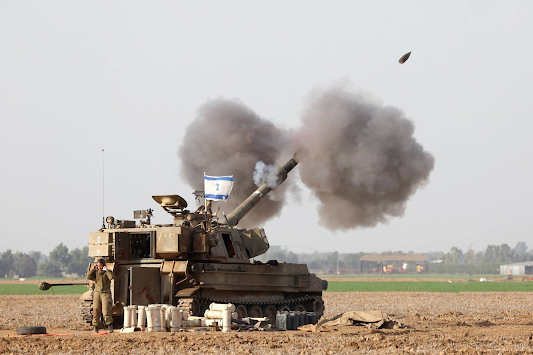
The Wall Street Journal - no enemy of Israel - has reported that the USA has, since the current hostilities began, sent to Israel over 15,000 bombs to be delivered by aircraft or drones. Some of these are 'bunker buster' bombs, which drill down into the target surface before exploding. Some of them are laser-guided 'precision' munitions. Many are, however, unguided 'iron' bombs or 'dumb' bombs, whose deployment as well as effect is completely indiscriminate. The United States has re-supplied Israel with 57,000 155mm howitzer shells, for use by the IDF's American-supplied M109 self-propelled guns. The blast radius or zone of lethality for a 155mm shell is about 50 metres i.e. anything within a football-pitch-sized area of the point of impact of such a shell may be damaged or destroyed. Here is a graphic which provides information on such shellfire. Note the figures on shrapnel projection from each shell-burst:
And here is an Israeli M109 in action:
The United States has also elected to send Israel large re-supplies of tank gun ammunition, to keep Israel's Merkava main battle tanks effective. On December 9, the Biden administration announced a manoeuvre to bypass the need for Congressional approval for the transfer of 14,000 shells to Israel (worth $106.4 million). This is part of a larger package which involved up to 45,000 tank shells. On the same day as the delivery was announced, State Department officials said that Washington was continuing to make it clear to Israel that it must comply with humanitarian law and avoid civilian casualties. Secretary of State Blinken provided detailed justification for the shells to Congress, arguing that their supply to Israel is in America's national security interest.
The shells will come from US Army inventories and consist of M830A1 MPAT 120mm tank cartridges and related components. The M830A1 MPAT is a type of tank ammunition used by the United States Army and Marine Corps. It is designed to provide a dual-purpose capability, with both anti-armour and anti-personnel effects. In the 120mm M830A1 MPAT (Multi-Purpose Anti-Tank) tank cartridges, the penetrator is made of depleted uranium, which provides increased density and armour-piercing capabilities. It is worth noting that depleted uranium (DU) ammunition, including the M830A1, has been subject to international debate and scrutiny due to concerns about the potential health and environmental risks associated with its use.
*****
Many analysts estimate that the kill rate due to Israeli munitions in Gaza is the highest any war or combat zone has witnessed since the Second World War.
*****
The United States is not Israel's only armourer - the UK supplies Israel with military support, and Germany has reiterated that the defence of the State of Israel is part of its 'staatsraison' or 'reason of state'. On the contortions of the latter, see Sabine Broeck's brilliant letter in the Massachussetts Review:
Staatsraison: Dispatch From Germany | Mass Review
*****
It is worth noting that Israel's overwhelming reaction currently in Gaza is not a new doctrine or approach. Many link it to the 'Dahiya doctrine', first articulated by IDF General Gadi Eizenkot during Israel's war with Hezbollah in Lebanon, in 2006. It involves the deliberate use of 'disproportionate' force against a guerrilla enemy. Here is Eizenkot in 2010:
The method of action in Lebanon [in 2006] was that, in the first stage targets were attacked which formed an immediate threat, and in the second stage the population was evacuated for its protection, and only after the evacuation of the population were Hezbollah targets attacked more broadly. I am convinced that this pattern was a moral pattern, that it was correct to use, and if another campaign is required it will be correct to act in the same way. It is Hezbollah which transforms the hundreds of villages and the Shiite areas of Lebanon into combat spaces. I hope this understanding will cause the organization to consider carefully before it decides to use any more terror, kidnapping, or shootings.
At least three things stand out in Eizenkot's statement: 1) the idea of moving the population out of the combat zone - an apparently 'humanitarian' move, which is then undercut two sentences later; 2) the rhetorical formulation whereby it turns out to be Hezbollah which 'transforms the hundreds of villages and the Shiite areas of Lebanon into combat spaces', blaming the victims ('it is the children of Gaza who have brought this upon themselves' - MK Meirav Ben-Ari of the 'liberal' and 'centrist' Yesh Atid); and 3) the conviction that the 'pattern was a moral pattern'. Thus, a theorist and senior officer of the most moral army in the world. But it must also be noted that Israel has long had a policy or tendency of responding with overwhelming force to Palestinian raids into Israel, going all the way back to the Qibya raid on the West Bank in 1953, led by the young Ariel Sharon, which was, according to Israel, occasioned by the murder of an Israeli woman and her two children, and which resulted in the deaths of 69 Palestinian civilians.
The Israeli approach is typical of colonial regimes - British, French, South African - which frequently conducted 'punitive raids' to cow the colonised in the nineteenth and on into the twentieth century. One notes the 'razzias' favoured by the French in their brutal pacification of Algeria, under Marechal Bugeaud in the 1840s - such as the extraordinary and savage massacre of the entire Ouled Rhia tribe, at Dahra - 900 men, women and children sealed up and suffocated in a cave. Or, even worse, the Sétif massacres of Algerian civilians by French forces in 1945. Algerians celebrating the surrender of Nazi Germany on May 8, 1945 were severely policed by the local gendarmerie, and flags and banners calling for national independence were confiscated. Reports from Sétif incited violence in the countryside, and 102 pieds-noirs settlers were murdered by Algerians. Over the following six weeks, in a series of ratissages, the French army and colonial militias and vigilantes slaughtered at least 6000 Algerians around Sétif and Guelma, possibly as many as 30,000, in reprisal.
*****
The United States has voted against at least two resolutions of the United Nations General Assembly calling for a ceasefire. The United States has also used its veto on the UN Security Council to block two resolutions - one in late October and one on December 8 - calling for unconditional ceasefire.
*****
Accordingly, one can say that the United States is grossly complicit in the Israeli massacre of 20,000 Palestinians which has taken place since October 7. The United States - as armourer, as military protector and ally, as diplomatic protector and ally, as ideological ally - is guilty of war crimes and gross crimes against humanity, including those of ethnic cleansing and genocide, in the Gaza Strip.
*****
Here are two impressive articles to read on this subject - at a time when the flow of information and commentary is so overwhelming, these writers help cut to more fundamental understanding.
Bashir Abu-Manneh is a senior scholar at the University of Kent, an old friend and admired colleague of mine and a fearless speaker on the condition of Palestine. Here he is interviewed by Daniel Finn, himself a prominent pro-Palestine commentator in both Britain and Ireland, in Jacobin:
Israel’s War on Gaza Is a Campaign of State Terrorism to Crush the Palestinian People
And here is Mearsheimer in conversation mostly about the same article, with Freddy Sayers of UnHerd: