Thursday, 1 August 2024

Coldness and Cruelty: Netanyahu's Willing Executioners?

 I can still remember the controversy raised by Daniel Jonah Goldhagen's book on the Holocaust, Hitler's Willing Executioners.  The book, published in 1996, stoked controversy (following on the German Historikerstreit about the interpretation of the Holocaust) for apparently suggesting that the entire German nation and population was gripped by an ahistorical anti-Semitism, and that this ideological climate facilitated the participation of 'ordinary Germans' in the slaughter of Jews.  Goldhagen felt that the debate between 'functionalists' and 'intentionalists' among Holocaust historians was itself a blind alley, and that the pervasiveness of anti-Semitism had not been taken fully into account.    


Goldhagen's work aroused passionate and even vitriolic responses.  The great Holocaust historian Raul Hilberg declared that Goldhagen was 'wrong about everything', and the Israeli historian Yehuda Bauer wrote that Goldhagen 'stumbled badly'.  Fritz Stern said that Goldhagen's book was gripped by an undeclared but saturating and essentializing Germanophobia.

Nevertheless, Goldhagen's book raises the question - he was not of course the first writer to discuss this theme - about the wider legitimacy accorded by German society to what was perpetrated by the Einsatzgruppen and in the death camps.  Now the Palestinian writer Faris Giacaman teases out some of the issues surrounding Israel's actions in Gaza and their relation to Israeli society with its various classes, ideological groupings and institutions.   He does this via a critical re-reading and discussion of Goldhagen's book.   


Here is Giacaman's important and interesting essay, published at the excellent Mondoweiss site:


Netanyahu’s willing executioners: how ordinary Israelis became mass murderers


Conor

Tuesday, 16 July 2024

The Neck and the Sword - This is what genocide looks like - and too bad if it makes you uncomfortable to think about it


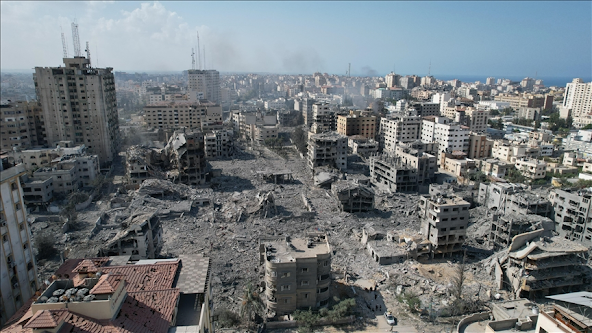
Despite, or maybe because of, the focus of the Western news media switching considerably away from Gaza in recent weeks, with the concentration instead on the French and British elections and the American presidential campaign, the brutality in Gaza goes on.   The last week, in particular, has seen a major increase in Palestinian deaths, with civilians massacred in 'safe areas'.    Large masses of people continue to be moved around the Strip by IDF fiat, moving to such 'safe areas' which then become free fire zones just like anywhere else.    The Irish political class - with the Oireachtas now on its summer recess - is no longer talking much about Palestine.    Students have gone home from university.     Protests happen, but there is no avoiding the awful contrast between the uptick in deaths in Gaza and the downtick in public agitation.   At least that's how it seems in Dublin.


Here is some reading to keep us all up to date and to bring us the 'bigger picture'.   Rashid Khalidi, whose superb work has often been referenced on this blog, has a long and impressive interview (conducted by the redoubtable Tariq Ali) in the current New Left Review:


Rashid Khalidi


And the courageous Israeli historian, Amos Goldberg, at Jacobin


Israeli Historian: This Is Exactly What Genocide Looks Like


And here is a tremendous blog piece by my redoubtable comrade and colleague, Ronit Lentin.   Ronit has been a pioneer in the study of racism in Ireland, but she's also a brave and steely writer and campaigner on the question of Palestine.   Here, riffing on Jonathan Glazer's film The Zone of Interest, she meditates on the way that some people are made 'uncomfortable' by the insistence that activists make that 'Palestine is still the question', and what this desire for 'comfort' means.


Conor

Sunday, 9 June 2024

Comrade, laureate of the barricade, inspiration - Éric Hazan


I feel very sad this evening.  A great writer and agitator, Éric Hazan, has died.  I never met Hazan, and now I never will.   But I felt powerfully that I had a sense of him from his books.   This is something one quite often feels about authors whose work one likes, but I felt it with regard to Hazan strongly.

Maybe 15 years ago, I noticed a book, probably in the Verso catalogue, that intrigued me.   The Invention of Paris.   I got a copy and gave a copy to someone else.  The someone else never read it, but no matter.  I read it, or I started reading it - probably on an early visit to Paris.   Sometime around 2010, I began to visit the city often.  My dear friends R and R booked me into a little hotel on the north side of the Butte of Montmartre, not far from their own tiny apartment on the delightfully named Rue Cyrano de Bergerac, and I met them and ambled around parts of the city.

R and R's chaperoning was important to me, because though I was fascinated by French culture and intellectual life, I was deeply embarrassed at the inadequacy of my French.   I was raised by a intensely Francophile mother, who even after years away from France was fluent in the language and read in the literature avidly.  My dear mother, so gentle and forgiving in most ways, was snobbish about French pronunciation, and would correct me and others around her for infractions on the beauty of the language.   So it may be that it's to her I owe my fear of using my French.   But then I reached middle age, and while I didn't have a crisis and I didn't buy a Porsche, I took myself in hand in various ways.  One of these was reminding myself of the obvious fact that the only way to improve my French was to use it, and to plunge into the country and the language without fear.    So, though visits to Paris might be a fairly gentle or even genteel immersion, I pushed myself to visit and explore the city.  And fell in love with it, of course.    R and R were cicerones to me at the start of that process.   Éric Hazan and The Invention of Paris were and will remain the guide and map of my love.

I had long been enamoured of French culture and intrigued by Parisian intellectual culture - the existentialists, the poststructuralists, French Marxism, the jousts of writers and activists.    I had read a bit of this stuff in English.  I had also been slowly working my way through the most famous nineteenth century French novelists - Stendhal, Flaubert, Zola and, particularly, Balzac.  I loved them all.  I still do.  I've read other French writers but these are my favourites.  I'd also encountered great non-French writers who could write brilliantly about the city - Walter Benjamin, in particular, but also the wonderful English Marxist geographer, still with us, David Harvey.  Harvey's epic tome, Paris: Capital of Modernity, is a great account of the city and its development.

But none of these books quite caught my heart as L'Invention de Paris.  Once I started reading it, with its chapters spiralling out from the old city core to the barren wilderness of the périphérique, I was completely entranced.   Paris must be one of the most written-about places on earth, and I make no claim to having read more than half an iota of that literature.   But I still want to say that Hazan's masterpiece is the best book ever written about the metropolis.    It is detailed, it is erudite, it is salty and pithy at times, it is furious and denunciatory at others.   Hazan has no compunction about describing certain developments of Paris as stupid or crude or vulgar or just shitty.   He is completely trenchant in his account.  Unsurprisingly, the book ends with a long account of 'Red Paris', the Paris of revolution and barricade (Hazan wrote a short brilliant book on the history of barricades), the Paris of the northeast, of Belleville and the industrial side of the city, now the part of the city of the immigrant communities, insofar as they have a toehold inside the ring road and beyond the banlieues.   


Over about a decade, until stopped by the Covid crisis, I visited Paris every year, sometimes twice a year.  I found a lovely little hotel in Montmartre that I  kept returning to. I went often just after Christmas, when the city was maybe a little quieter than in midsummer.    I walked as much as I could.   I followed routes set out by Hazan across the city, in later books.   But always I carried The Invention of Paris with me.  I enjoyed it so much that I would smile for sheer happiness when reading it alone on the metro, for sheer pleasure at the writing.   I was not using the book as a guidebook, though one could do so.  It's not written as a guide, but as a psychogeographical history of Paris.   But revisiting it, with a good map spread out on the table, is a pleasure too, even when at home in Dublin.   


Hazan was a remarkable man.    Trained as a heart surgeon, he quit the medical profession in his fifties and became a writer and publisher.   His company, La Fabrique, now stands as a pre-eminent, though small, publisher of the French left, such as remains of that left.   Hazan and his books, and his colleagues at La Fabrique, remain a beacon.  I write this tonight, when the French right has won sweeping gains in the European elections and President Macron has called a snap general election.    To say that Hazan would have had strong  opinions about this would be a feeble understatement - he'd be firing off acrid but acute commentary: clever, committed, utterly fearless.


Here is Tariq Ali's obituary to Hazan, from the Verso website:


Self-quotation is usually an unattractive and pompous trait.   But I will allow myself to post in some past blogposts that discuss Hazan:


Reading and Walking in Paris - The incomparable Eric Hazan


Better Fewer, But Better - Walking and Reading in Paris


At the Mur des Fédérés - remembering the Paris Commune


Conor

Friday, 24 May 2024

Boycotting Israel - Being Bullied By Israel


Apoplectic responses by Netanyahu and much of the Israeli political class to the recent declarations by the International Criminal Court and now the International Court of Justice show Israel to be a bully state, a rogue state, a state whose leaders and many of its citizens are so used to getting their own way that the slightest progress for the Palestinian cause or the Palestinian people infuriates them.    But the world is waking up to the fact of Israeli arrogance, brutality, racism and crudeness.   The tantrums of Israel reveal a condition of desperation, where the state feels that its 'moral armour' (as Said called it) is no longer proof, in the eyes of most of the world.  


In recent days, Ireland has felt some of Israel's current fury.   The decision of the Irish government, along with the leaders of Spain and Norway, to 'recognise the state of Palestine' has drawn displays of petulance, ire and bullying that are striking - but telling - to behold.   The Israeli Foreign Ministry Tweeted a video of Irish dancers intercut with images of Hamas gunmen.   Yisrael Katz, the Foreign Minister, called the Irish declaration a 'parade of stupidity'.   The Israeli ambassadors to Ireland, Spain and Norway have been recalled, and the Irish, Norwegian and Spanish ambassadors have been summoned by the Israeli government to be brow-beaten and shown videos.  This dressing-down has been shown on Israeli TV - surely a breach of diplomatic protocol, all the more striking when it comes from 'the only democracy in the Middle East'.  Dana Erlich, the Israeli Ambassador to Ireland, has suggested in an interview (presumably recorded just before she mercifully headed for the airport) that Ireland has an 'unhealthy obsession with Israel'.    She'd be better employed realizing that Israel has an unhealthy obsession with itself, its exceptionalism, its self-appointed status as 'a light to the nations', its self-appointed status as 'the essential refuge of the Jewish people'.    Just in the last few days, Netanyahu trotted out that hoary old shit about the IDF as 'the most moral army in the world'.   The best answer to such stuff was given some weeks ago in a brilliant letter to the Irish Examiner by my comrade Sue Pentel, a member of Jews for Palestine - Ireland, where she pointed out that Jews do not need Zionism to be Jewish and do not need Israel to be safe.    

 Never has the case for boycotting Israeli institutions, and Israeli education institutions, been more cogent.


Reading ...


Mitchell Plitnick at Mondoweiss:


Biden and Congress are destroying International Law for Israel


Michael Gasser at Mondoweiss:


Michael Arria at Mondoweiss


‘We have reached unprecedented levels of support for Palestine on this campus’: a student on Oxford’s Gaza Solidarity Encampment


Marcia Newman at Mondoweiss


David Palumbo-Liu, reviewing Nick Riemer at Jacobin:


Amia Srinivasan at the London Review of Books, on campus speech:


Conor

Wednesday, 15 May 2024

An Nakba - The Meaning of the Catastrophe

In 1948, the Syrian intellectual and historian Constantine Zurayk wrote a book, The Meaning of the Disaster, which staged a major confrontation with the collapse and destruction of Palestinian society that accompanied the birth of Israel: the sweeping away of most of Palestine's Arab population by the Zionist militias and the IDF, and the failure of the Arab states to take effective action in support of their Palestinian brothers and sisters.  The term 'an Nakba', 'the catastrophe' came into widespread use at least partly because of Zurayk's unsentimental and rigorous analysis: Ma'na al nakba.   


Today, May 15 is called by Palestinians (and recognised by the UN as) Nakba Day, the commemoration of the disaster that overtook Palestine as the new State of Israel was born.   It follows immediately on May 14, when, in 1948, David Ben-Gurion read aloud the 'Declaration of the State of Israel', at Beit Dizengoff in Tel Aviv, and, along with the other members of the Provisional State Council, signed it.

This moment of triumph and exultation for Zionism was accompanied by ethnic cleansing, murder, brute violence, chaos, social and political fragmentation and historical rupture as experienced by Palestinians.  

It is essential to realise, however, that the State of Israel did not come out of nowhere, and the assault on Palestinians did not begin on May 14, 1948.   The important Palestinian historian Rashid Khalidi argues that the century-long war on the Palestinians began with the Balfour Declaration of 1917, when the British government, which did not yet control Palestine, declared its interest in the creation of a 'Jewish homeland' in the territory.   The Declaration stands as a declaration of war; indeed in its rhetoric and presuppositions it is an act of war, in its setting aside of Palestinian wishes and its negation of any sense of Palestine as a polity or of Palestinians as political subjects.   The Zionist project did not start in 1948 or, indeed, in 1917.   The political movement began with the publication of Herzl's Der Judenstaat in 1896 and the holding of the first meeting of the World Zionist Organisation in 1897.   

In other words, the events of 1947 - 1949 were not a beginning but were, in their way, a culmination.    A new state, long prepared, thought about, theorized, agitated for, planned, organised and set up ab ovo long before May 1948.   The new state was a testament to Zionist determination, zeal and rigour - the product of what Edward Said called 'a discipline of detail'.   It was also, of course, a testament to British vacillation, UN passivity, Arab incompetence and by and large a total lack of planning by the Palestinian elite.

Approximately 750,000 people fled historical Palestine during the Nakba.   The process was accompanied, as we now know and as Palestinian historians have said for a very long time, by brutality, heartlessness, murder, cynicism and massacre.    

I used to see the Nakba as the ultimate disaster which had befallen the Palestinians.   And in historical terms, it remains that.  But in terms of sheer violence and casualties, it was probably exceeded by the Lebanon War of 1982, when the IDF stormed north, shoving UN forces and Palestinian militias aside and arrived after about a week at the outskirts of Beirut.  Israeli forces then laid siege to Beirut all summer  long, lobbing thousands of artillery shells into the city and dropping thousands of bombs on a target entirely without anti-aircraft defences, pulverizing it and slaughtering tens of thousands of Lebanese and Palestinian civilians.   The world looked on aghast.  Even Ronald Reagan appealed to Menachem Begin for the onslaught to stop.   But no: Mr Begin, former leader of the Irgun Zionist militia notorious for the Dayr Yassin massacre of April 1948 announced that Hitler himself was hiding in Beirut and needed to be rooted out.    The rooting-out duly went ahead and culminated in the Sabra and Shatila massacres, where 1700 Palestinian and Lebanese civilians were savagely murdered by Israel's Phalangist allies. The IDF - 'the most moral army in the world' - looked on and played Simon and Garfunkel songs on its PA systems, occasionally shooting flares into the night sky over the camps to allow the butchery to continue.


And now we have the Gaza massacre - to call what has happened since October a 'war' is largely to bend sense - in which the casualty rates are even worse.   At least 35,000 dead in seven months, of whom 70% have been women and children.  And the response of the world is even more bizarre, crass and inhumane than in past times.  America arms Israel to the teeth.   Germany reiterates that the defence of Israel is part of its 'reason of state'.   The British Labour Party leader, Keir Starmer, declares that cutting  of all necessities to civilians - food, water, electricity - is a legitimate act of war.   The President of the European Commission, a leader with no democratic mandate in the Union or elsewhere, flies to Israel to declare her support.   Irish politicians say nice things but take no practical actions.    The current plans of the Irish government to recognise 'the state of Palestine' fly in the face of the complete lack of Palestinian sovereignty - an essential  component of statehood - in either the Gaza Strip or the West Bank.    The IDF invades Rafah, and President Biden - one of the most ferociously Zionist of American politicians, who encouraged Menachem Begin back in 1982 to go ahead and murder women and  children in Lebanon - offers Israel more military aid.


The brilliant writer Pankaj Mishra wrote recently in the London Review of Books of the way that the Western governmental response to what Israel is doing amounts to a comprehensive tearing-up of the structures and values of humanitarianism, law and protection against genocide, put in place after 1945.  'Gaza after the Shoah' amounts to an evisceration of any residual right of the Western powers to claim to humanitarianism, decency, international legitimacy as their prerogatives.  Gaza is not just a disaster, another Nakba, for Palestinians (and in the perfervid expressions of members of Israeli political society, cheerleading every shell and every bomb).  The supposed 'Jewish state' is shredding the whole legal apparatus instituted to make sure that another holocaust could not happen.    And it is being cheered on by the leaders of the Western world, enthralled by a 'McCarthyite philo-semitism' (in Nancy Fraser's words) which so clearly demonstrates the relationship of Zionism to the forces it apparently opposes.  This is a moral and political disaster of the first order for the entire global system. 

There is so much to read on Palestine these days that me pointing to such things may be irrelevant.  But here we go.


Rashid Khalidi at Jacobin:


Rashid Khalidi: Violent Settler Colonialism Caused This War

Seraj Assi at Jacobin:


The Ethnic Cleansing of Palestine Never Ended


Here is Mishra's essay at the LRB


The Shoah after Gaza


Jodi Dean at Verso:


Conor


Friday, 10 May 2024

The Rolling Wave - Maynooth University BDS Protest Escalates


First of all, the statement put out earlier today by those organising the powerful sit-in protest at Maynooth:


Press Release 

FOR IMMEDIATE RELEASE

Maynooth University Students and Workers Demand Action on Palestinian Genocide 

Maynooth, Ireland - [10/05/2024] - The Maynooth University community is intensifying its call for justice amidst the ongoing genocide in Occupied Palestine by disrupting the President’s address to the Sociological Association of Ireland annual conference today at 12.45pm in the foyer of the School of Education building, and holding a sit-in in the conference location for the rest of the day. With this disruption, students and postgraduate workers are demanding immediate action from President Leinonen and the university administration, urging them to take a firm stance against the genocide being committed and to sever ties with the occupying Israeli state and complicit companies.

In a letter directed to President Leinonen and publicly read out as she was due to make her address, the group emphasises the urgent need for Maynooth University to condemn the ongoing genocide in Gaza and to make a binding commitment to the principles of the Boycott, Divestment, Sanctions (BDS) movement and the academic boycott of Israeli institutions. They highlight the significant precedent set by Trinity College Dublin's condemnation of the genocide and commitment to divest, and stress the necessity for Maynooth to follow suit. 

The demands put forth by the group include issuing a public statement condemning the genocide, committing to the principles of the Boycott, Divestment, Sanctions (BDS) movement, collaborating in the Palestinian-led restoration of academic institutions in Gaza,, providing sanctuary and scholarships for 100 displaced Palestinian students and scholars, and the severing of ties with Intel, a company that has invested 25 billion USD in Israel since the start of this current phase of genocide. They note Maynooth University’s research partnership with Intel, in place since 2019, particularly the recent Intel investment in a robotics lab on campus. In the context of Intel’s investments in the genocidal State of Israel, such partnerships should be unacceptable to any institution of conscience. 

Through this disruptive action, the group aims to draw attention to the university's silence and inaction on the genocide of Palestinians and to underscore the urgency of their cause. They vow to escalate disruptive actions until Maynooth University makes a good faith commitment towards their demands. 

For media inquiries, please contact

Sian Cowman 083 403 1185 / siancowman@gmail.com

Criostóir King 087 613 3894 / criostoirking@gmail.com

About Maynooth BDS

Maynooth BDS is a coalition of students and postgraduate workers at Maynooth University dedicated to advocating for justice, equality, and human rights in Palestine. They work in solidarity with the global BDS movement to pressure institutions and corporations to end complicity in Israeli apartheid and occupation.

Follow Us:

Twitter: MaynoothBDS

Instagram: MaynoothBDS


Here is an image of the action:


Maynooth BDS on X: "Sit-in happening now! 🇵🇸 @maynoothsu https://t.co/4I7trMSJQD" / X (twitter.com)


Second, the immediately following statement from Academics for Palestine, supporting the students and grad student workers:


AFP SUPPORTS MAYNOOTH STUDENTS’ SOLIDARITY

Standard

Academics for Palestine strongly support the demands made today by student activists in Maynooth University. In joining the Palestine solidarity actions that have spread across university campuses in the United States, France, Australia, Britain, India, Brazil, Tunisia, Netherlands, German, Japan and beyond, these students are showing a degree of moral courage and leadership that has been distinctly lacking among our university administrations. 

This week’s decision by Trinity College Dublin to condemn the ongoing genocide, divest from Israeli companies, and review all ties with Israeli institutions sets an important precedent which must be followed in universities throughout Ireland. Not to do so would bring shame on university leadership, who would be forever remembered as being on the wrong side of history.

Across the island of Ireland, we have witnessed our university administrations legitimate their 7 months of silence on Israel’s atrocities against the Palestinian people by asserting that they are holding a neutral position in defence of academic freedom. To remain silent in the face of this genocidal war on occupied Palestine is not neutrality, but complicity. Nor is the call for ceasefire a controversial matter; it has the overwhelming support of the people of Ireland as well as the Irish government.  We support the students’ demands that Irish universities take concrete steps. Over the past 7 months, the demands of student groups, third-level campus staff groups, and Academics for Palestine have been expressed repeatedly and consistently.

They include:


1) Severing any existing institutional partnerships, projects or affiliations with Israeli universities and state institutions.
2) Disclosing and divesting from any financial complicity in Israeli occupation and from companies involved in violations of Palestinian rights.
3) Divesting from any holdings in companies associated with weapons development or arms manufacturing, and withdrawal from any projects involving partners associated with the Israeli security, surveillance technology or arms industries.
4) Making an unequivocal statement of solidarity with the people of Palestine, condemning the ongoing genocide, apartheid and occupation they face.
5) Committing to provide substantial material and logistical support for displaced Palestinian students and academics to study and work in Ireland.

These demands should no longer be cast as radical; they are the least our institutions should be doing amidst the ongoing destruction of Gaza. The ongoing invasion and bombardment of Rafah, described by UNICEF as a ‘children’s city’ due to the 600,000 children currently seeking safety there, adds a particular urgency to the situation.

The Maynooth students who have taken action today follow the lead of principled student movements as well as the longstanding principles of the civil society-led Palestinian Campaign for the Academic and Cultural Boycott of Israel. Indeed, Irish third-level institutions are completely out of step with the broader public in Ireland in their refusal to deplore the Israeli state’s genocidal atrocities in Palestine. So we will continue to repeat and insist on these demands until they are met. We do so inspired by our own students and students rising around the world, and with the aim of reclaiming Irish universities as spaces of justice, anti-racism, and anti-colonialism.

Here is the AfP website: Academics for Palestine – Academia Against Apartheid

Conor