Saturday, 17 August 2024

The Kind of Letter the Irish Times Will Not Publish

 I've been writing letters to the Irish Times for years.    In my teens, I wrote, on my mother's old typewriter, an angry reply to some moron who'd suggested that famine in Africa was largely created by African governments and had no relationship to the colonial history of the continent.    For a long time in the 1990s and early 2000s, it seemed (to me, of course) that Raymond Deane - later to become a dear friend and comrade - and I were the only people writing cogent letters to the papers about Palestine.   We wrote well and our letters were often published.   We got hate mail and furious replies.


Not so any more, or not for me.   My Irish Times letter glory days are over - probably mercifully for everyone else, and probably mercifully for me.   The Irish Times doesn't publish my letters, though some of my colleagues, including Raymond, still regularly get published.   Raymond's high profile in Palestine activism - a lot higher than mine - gives his brilliant letters a representative character which mine lack.   But it's probably a good thing my letters are no longer published.   It would be as well not to be precious about these things - not when the IDF has murdered many dozens of journalists who are at the real sharp end of things in the Strip.  And there are other ways of finding a readership.

And yet - these days, as the genocide in Gaza continues and only occasionally is considered newsworthy, as the brutality of Israel becomes ever-more obvious, as the moral and political cowardice of the United States and the European Union on the issue becomes more and more shameful, I am stung into writing.    Last week, the Irish Times published an editorial of more than usual mediocrity and caution, noting that Ireland was likely to suffer a diplomatic riposte from Israel similar to one just borne by Norway, because of the 'support' both countries have expressed for something called 'Palestinian statehood'.  And the editorialist noted that while Israel might furiously denounce Ireland and Norway, the correct Irish response was to maintain, like Norway, a self-characterisation as a 'friend of Israel'.   This came in the week when the Gaza death toll passed 40,000.   


So I wrote the letter I will post below.  It was not published because it criticizes the Irish Times and that newspaper takes itself very seriously, with an amour propre akin to that of the New York Times.    The letter, most readers will find, is not actually very radical at all - for most people, the horror that Israel perpetrates in Gaza is so clearly barbaric and disgusting that one does not have to be a wide-eyed leftist to recognise it.    But the Irish Times has not twigged this yet.   I will not be holding my breath until it does.

Here's the letter:


August 16, 2024

Dear Sir

We have now passed the 40,000 mark in Palestinian deaths at the hands of the Israeli Defence Forces in the Gaza Strip since October.   A recent article in the distinguished medical journal The Lancet suggested that the death toll might actually be as high as 186,000.   In this context, the recent Irish Times editorial on the situation in Israel and Gaza  and Israel's furious diplomatic response to Irish and Norwegian support for Palestinian statehood ('Building Tensions, 12/8\24) is a morally and politically weak and frankly pathetic response to the apocalypse which has been unfolding in Gaza since October 7 last and which shows absolutely no sign of change or improvement.    

In a 'conflict' which has witnessed the most intense bombardment of an urban space in recent memory, which has seen the fastest deliberate starvation of any population in recorded history, which has seen the greatest number of journalists killed in any conflict in the world, and which has seen the greatest number of UN staff murdered in any period, how can anyone, even in the euphemistic language of diplomacy, see any value in Ireland casting itself as a 'friend of Israel'?   

 To stress 'friendship with Israel' in the same week as the Israeli Finance minister suggested that to starve the entire population of the Strip would be 'just and moral' is akin to declaring that Ireland is a friend of the Ku Klux Klan.   The last thing Ireland should be doing is 'echoing' the feeble and equivocating words of the Norwegian government.   It is time Irish politicians and Irish newspapers including the Irish Times, woke up and named what is happening in Gaza for what it is, and named Israel for what it is - a racist state bent on ethnic cleansing or genocide.

yours sincerely

Conor McCarthy

Tuesday, 6 August 2024

Coming to terms with reality - reading John Mearsheimer on Ukraine, again

This blog has long shown its interest in and admiration for John Mearsheimer, the University of Chicago international relations scholar and theorist.     I've been reading Mearsheimer since 1990 and I've read several of his books, including his masterpiece, The Tragedy of Great Power Politics (2001).    This book, published at the peak of what he calls the 'unipolar moment', when the United States made a 'Faustian bid' (in Peter Gowan's words) for global dominance, cheerfully punctured the language of the American-led 'rules based order' and showed that great power rivalry was no thing of the past, apparently replaced by Kantian universal peace and the 'new world order' at 'the end of history'.  Rather the rise or return of older great powers - Russia, China - or the emergence of new ones - India, Brazil - would contribute to an increasingly unstable, fraught and potentially violent disorder in global politics.    This has all duly come to pass.


Mearsheimer long ago offered a discomfiting prognosis of the Ukraine crisis - a video of a talk he gave at the time of the annexation of the Crimean peninsula has been viewed 29 million times and carries over 18,000 comments - where he suggested that the major driver of the problem was the determination of the West to push NATO and EU membership right up to Russia's borders, by bringing Ukraine and Georgia into the fold.    This basic element of Mearsheimer's analysis has always struck me as correct and crucial.    It's a matter of a Russian Monroe Doctrine - we can all imagine what the American reaction would be if a Russian or Chinese military alliance were to extend membership to Mexico or Canada; we all remember (or we should remember) what the reaction was of the Kennedy administration to Soviet efforts to deploy medium range ballistic missiles to Cuba in 1962.    We in Ireland could even speculate productively as to what the British response might be if Ireland were to enter a defence treaty with Russia.    It would not be a happy reaction, for sure.   Shades of Churchill's ugly comments about Ireland's neutrality in the spring of 1945.


None of this suggests that the Russian regime is innocent of invading Ukraine, or that it is a charmingly anti-imperialist government, or that the war has not been conducted with great brutality.   None of this suggests that Russia is a democracy; it's not.   But that is not the point: the point is that an apparently moralising foreign policy brings with it severe problems: it leads the United States into actions and interventions which are driven by realpolitik even as they are cloaked in liberal rhetorics.   Some American politicians, and many American people, actually believe the liberal language.


Mearsheimer now has a personal website - Mearsheimer | Home  - which is chock-full with links to his essays and books.  He also now maintains a Substack blogsite where links to his many appearances in the media can be found.  He's now published a new essay on the Ukraine war, on this Substack site.   It's well worth reading.


Thursday, 1 August 2024

Coldness and Cruelty: Netanyahu's Willing Executioners?

 I can still remember the controversy raised by Daniel Jonah Goldhagen's book on the Holocaust, Hitler's Willing Executioners.  The book, published in 1996, stoked controversy (following on the German Historikerstreit about the interpretation of the Holocaust) for apparently suggesting that the entire German nation and population was gripped by an ahistorical anti-Semitism, and that this ideological climate facilitated the participation of 'ordinary Germans' in the slaughter of Jews.  Goldhagen felt that the debate between 'functionalists' and 'intentionalists' among Holocaust historians was itself a blind alley, and that the pervasiveness of anti-Semitism had not been taken fully into account.    


Goldhagen's work aroused passionate and even vitriolic responses.  The great Holocaust historian Raul Hilberg declared that Goldhagen was 'wrong about everything', and the Israeli historian Yehuda Bauer wrote that Goldhagen 'stumbled badly'.  Fritz Stern said that Goldhagen's book was gripped by an undeclared but saturating and essentializing Germanophobia.

Nevertheless, Goldhagen's book raises the question - he was not of course the first writer to discuss this theme - about the wider legitimacy accorded by German society to what was perpetrated by the Einsatzgruppen and in the death camps.  Now the Palestinian writer Faris Giacaman teases out some of the issues surrounding Israel's actions in Gaza and their relation to Israeli society with its various classes, ideological groupings and institutions.   He does this via a critical re-reading and discussion of Goldhagen's book.   


Here is Giacaman's important and interesting essay, published at the excellent Mondoweiss site:


Netanyahu’s willing executioners: how ordinary Israelis became mass murderers


Conor

Tuesday, 16 July 2024

The Neck and the Sword - This is what genocide looks like - and too bad if it makes you uncomfortable to think about it


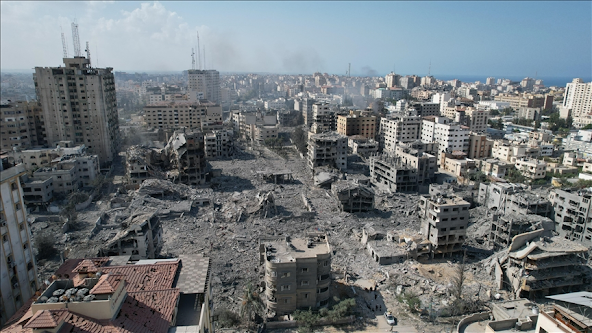
Despite, or maybe because of, the focus of the Western news media switching considerably away from Gaza in recent weeks, with the concentration instead on the French and British elections and the American presidential campaign, the brutality in Gaza goes on.   The last week, in particular, has seen a major increase in Palestinian deaths, with civilians massacred in 'safe areas'.    Large masses of people continue to be moved around the Strip by IDF fiat, moving to such 'safe areas' which then become free fire zones just like anywhere else.    The Irish political class - with the Oireachtas now on its summer recess - is no longer talking much about Palestine.    Students have gone home from university.     Protests happen, but there is no avoiding the awful contrast between the uptick in deaths in Gaza and the downtick in public agitation.   At least that's how it seems in Dublin.


Here is some reading to keep us all up to date and to bring us the 'bigger picture'.   Rashid Khalidi, whose superb work has often been referenced on this blog, has a long and impressive interview (conducted by the redoubtable Tariq Ali) in the current New Left Review:


Rashid Khalidi


And the courageous Israeli historian, Amos Goldberg, at Jacobin


Israeli Historian: This Is Exactly What Genocide Looks Like


And here is a tremendous blog piece by my redoubtable comrade and colleague, Ronit Lentin.   Ronit has been a pioneer in the study of racism in Ireland, but she's also a brave and steely writer and campaigner on the question of Palestine.   Here, riffing on Jonathan Glazer's film The Zone of Interest, she meditates on the way that some people are made 'uncomfortable' by the insistence that activists make that 'Palestine is still the question', and what this desire for 'comfort' means.


Conor

Sunday, 9 June 2024

Comrade, laureate of the barricade, inspiration - Éric Hazan


I feel very sad this evening.  A great writer and agitator, Éric Hazan, has died.  I never met Hazan, and now I never will.   But I felt powerfully that I had a sense of him from his books.   This is something one quite often feels about authors whose work one likes, but I felt it with regard to Hazan strongly.

Maybe 15 years ago, I noticed a book, probably in the Verso catalogue, that intrigued me.   The Invention of Paris.   I got a copy and gave a copy to someone else.  The someone else never read it, but no matter.  I read it, or I started reading it - probably on an early visit to Paris.   Sometime around 2010, I began to visit the city often.  My dear friends R and R booked me into a little hotel on the north side of the Butte of Montmartre, not far from their own tiny apartment on the delightfully named Rue Cyrano de Bergerac, and I met them and ambled around parts of the city.

R and R's chaperoning was important to me, because though I was fascinated by French culture and intellectual life, I was deeply embarrassed at the inadequacy of my French.   I was raised by a intensely Francophile mother, who even after years away from France was fluent in the language and read in the literature avidly.  My dear mother, so gentle and forgiving in most ways, was snobbish about French pronunciation, and would correct me and others around her for infractions on the beauty of the language.   So it may be that it's to her I owe my fear of using my French.   But then I reached middle age, and while I didn't have a crisis and I didn't buy a Porsche, I took myself in hand in various ways.  One of these was reminding myself of the obvious fact that the only way to improve my French was to use it, and to plunge into the country and the language without fear.    So, though visits to Paris might be a fairly gentle or even genteel immersion, I pushed myself to visit and explore the city.  And fell in love with it, of course.    R and R were cicerones to me at the start of that process.   Ã‰ric Hazan and The Invention of Paris were and will remain the guide and map of my love.

I had long been enamoured of French culture and intrigued by Parisian intellectual culture - the existentialists, the poststructuralists, French Marxism, the jousts of writers and activists.    I had read a bit of this stuff in English.  I had also been slowly working my way through the most famous nineteenth century French novelists - Stendhal, Flaubert, Zola and, particularly, Balzac.  I loved them all.  I still do.  I've read other French writers but these are my favourites.  I'd also encountered great non-French writers who could write brilliantly about the city - Walter Benjamin, in particular, but also the wonderful English Marxist geographer, still with us, David Harvey.  Harvey's epic tome, Paris: Capital of Modernity, is a great account of the city and its development.

But none of these books quite caught my heart as L'Invention de Paris.  Once I started reading it, with its chapters spiralling out from the old city core to the barren wilderness of the périphérique, I was completely entranced.   Paris must be one of the most written-about places on earth, and I make no claim to having read more than half an iota of that literature.   But I still want to say that Hazan's masterpiece is the best book ever written about the metropolis.    It is detailed, it is erudite, it is salty and pithy at times, it is furious and denunciatory at others.   Hazan has no compunction about describing certain developments of Paris as stupid or crude or vulgar or just shitty.   He is completely trenchant in his account.  Unsurprisingly, the book ends with a long account of 'Red Paris', the Paris of revolution and barricade (Hazan wrote a short brilliant book on the history of barricades), the Paris of the northeast, of Belleville and the industrial side of the city, now the part of the city of the immigrant communities, insofar as they have a toehold inside the ring road and beyond the banlieues.   


Over about a decade, until stopped by the Covid crisis, I visited Paris every year, sometimes twice a year.  I found a lovely little hotel in Montmartre that I  kept returning to. I went often just after Christmas, when the city was maybe a little quieter than in midsummer.    I walked as much as I could.   I followed routes set out by Hazan across the city, in later books.   But always I carried The Invention of Paris with me.  I enjoyed it so much that I would smile for sheer happiness when reading it alone on the metro, for sheer pleasure at the writing.   I was not using the book as a guidebook, though one could do so.  It's not written as a guide, but as a psychogeographical history of Paris.   But revisiting it, with a good map spread out on the table, is a pleasure too, even when at home in Dublin.   


Hazan was a remarkable man.    Trained as a heart surgeon, he quit the medical profession in his fifties and became a writer and publisher.   His company, La Fabrique, now stands as a pre-eminent, though small, publisher of the French left, such as remains of that left.   Hazan and his books, and his colleagues at La Fabrique, remain a beacon.  I write this tonight, when the French right has won sweeping gains in the European elections and President Macron has called a snap general election.    To say that Hazan would have had strong  opinions about this would be a feeble understatement - he'd be firing off acrid but acute commentary: clever, committed, utterly fearless.


Here is Tariq Ali's obituary to Hazan, from the Verso website:


Self-quotation is usually an unattractive and pompous trait.   But I will allow myself to post in some past blogposts that discuss Hazan:


Reading and Walking in Paris - The incomparable Eric Hazan


Better Fewer, But Better - Walking and Reading in Paris


At the Mur des Fédérés - remembering the Paris Commune


Conor

Friday, 24 May 2024

Boycotting Israel - Being Bullied By Israel


Apoplectic responses by Netanyahu and much of the Israeli political class to the recent declarations by the International Criminal Court and now the International Court of Justice show Israel to be a bully state, a rogue state, a state whose leaders and many of its citizens are so used to getting their own way that the slightest progress for the Palestinian cause or the Palestinian people infuriates them.    But the world is waking up to the fact of Israeli arrogance, brutality, racism and crudeness.   The tantrums of Israel reveal a condition of desperation, where the state feels that its 'moral armour' (as Said called it) is no longer proof, in the eyes of most of the world.  


In recent days, Ireland has felt some of Israel's current fury.   The decision of the Irish government, along with the leaders of Spain and Norway, to 'recognise the state of Palestine' has drawn displays of petulance, ire and bullying that are striking - but telling - to behold.   The Israeli Foreign Ministry Tweeted a video of Irish dancers intercut with images of Hamas gunmen.   Yisrael Katz, the Foreign Minister, called the Irish declaration a 'parade of stupidity'.   The Israeli ambassadors to Ireland, Spain and Norway have been recalled, and the Irish, Norwegian and Spanish ambassadors have been summoned by the Israeli government to be brow-beaten and shown videos.  This dressing-down has been shown on Israeli TV - surely a breach of diplomatic protocol, all the more striking when it comes from 'the only democracy in the Middle East'.  Dana Erlich, the Israeli Ambassador to Ireland, has suggested in an interview (presumably recorded just before she mercifully headed for the airport) that Ireland has an 'unhealthy obsession with Israel'.    She'd be better employed realizing that Israel has an unhealthy obsession with itself, its exceptionalism, its self-appointed status as 'a light to the nations', its self-appointed status as 'the essential refuge of the Jewish people'.    Just in the last few days, Netanyahu trotted out that hoary old shit about the IDF as 'the most moral army in the world'.   The best answer to such stuff was given some weeks ago in a brilliant letter to the Irish Examiner by my comrade Sue Pentel, a member of Jews for Palestine - Ireland, where she pointed out that Jews do not need Zionism to be Jewish and do not need Israel to be safe.    

 Never has the case for boycotting Israeli institutions, and Israeli education institutions, been more cogent.


Reading ...


Mitchell Plitnick at Mondoweiss:


Biden and Congress are destroying International Law for Israel


Michael Gasser at Mondoweiss:


Michael Arria at Mondoweiss


‘We have reached unprecedented levels of support for Palestine on this campus’: a student on Oxford’s Gaza Solidarity Encampment


Marcia Newman at Mondoweiss


David Palumbo-Liu, reviewing Nick Riemer at Jacobin:


Amia Srinivasan at the London Review of Books, on campus speech:


Conor